uconn

Important Notice on Proposal Submission Policy

Revision Date: March 8, 2021 – revisions in italics

As an applicant organization, UConn/UConn Health has an institutional responsibility to verify the accuracy, validity, conformity, and eligibility of all applications submitted to a sponsor on behalf of the University. We have been exploring how to ensure the best delivery of services, meet sponsor and institutional policy requirements that were highlighted in the recent NSF audit, and to ensure that the University has sufficient time to review and certify proposals and increase the number of successful applications. To that end, we have conducted a survey of all faculty who submitted grant proposals within the last two years, listened to the research community’s comments at town halls, and solicited input from the President, Provost, deans, associate deans for research, the President’s Research Advisory Council, University Senate, and other faculty groups.

This listening process revealed that one of the main challenges for both investigators and staff is the bottleneck that occurs immediately prior to proposal submission. In recent years, nearly two-thirds of proposals submitted (with all components ready) are received by Sponsored Program Services (SPS) within one working day or less of the sponsor deadline.

Numerous proposals are being submitted just barely in time, meaning there is little time for a thorough review. Additionally, proposals that have been submitted to SPS far in advance also routinely lack a timely and thorough review because other proposals with an earlier deadline came in and “cut the line.”

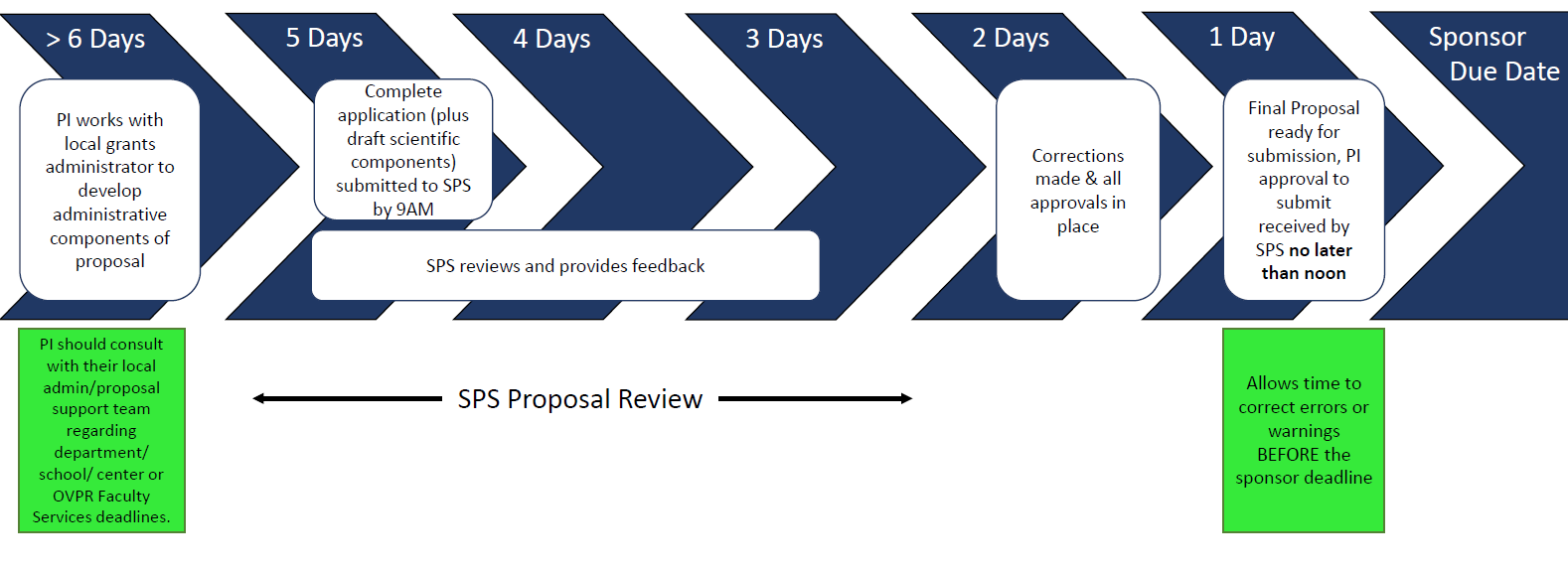
To begin to remedy the proposal submission bottleneck, beginning May 5, 2021, the Office of the Vice President for Research (OVPR) will implement the current policy on internal deadlines for the review and submission of sponsored project proposals. The process change aims to reduce last day proposal submissions and will prioritize proposals as received. Once the policy is implemented, final administrative components of a proposal must be received by SPS Pre-Award at least five full business days in advance of the submission due date (along with a draft of the scientific components). The final submission ready proposal is due to SPS no later than noon the day before the sponsor deadline.

Exceptions include short turnaround RFPs, last minute sponsor requests, or a last minute opportunity to join a proposal under submission by another institution. Also, each UConn investigator will be given one pass to use in the event they are not able to meet the internal five-day deadline. As is the current practice, SPS Pre-Award will make every effort to submit these proposals when possible. Please visit the OVPR website for additional information and FAQs regarding the internal deadline policy.

To increase faculty support related to proposal preparation, the OVPR will be taking the following additional steps:

  • The OVPR is working to address situations where investigators do not have dedicated administrative support for the preparation of a proposal; we will continue to increase staff training opportunities, extend faculty service offerings, and work to simplify the submission process.
  • The OVPR will implement a dashboard to increase transparency and provide information on the status and order of review.
  • The OVPR will provide additional research development services, such as grant editing and proofreading, proposal review, large and complex grant support, and research funding consultation. Further information regarding these services and how to request them is available on the OVPR Research Development section of this website.
  • The OVPR will continue to work with and incorporate feedback from faculty working groups.  Upon recommendation of the University Senate, the President formed a sponsored projects working group to identify impediments to the expeditious review of sponsored project proposals in advance of deadlines.  The group’s report is available on the University Senate website.

Development, review, and submission timeline:

Full Business Days Before Submission Deadline

>6 days: PI provides application components to local grants administrator (or Faculty Services)

5 days: Complete application (plus draft scientific components) and IPR submitted to SPS

5-2 days: SPS reviews proposal and provides feedback

2 days: Corrections made and all approvals in place

Noon day before deadline: Final proposal and PI authorization to submit to sponsor provided to SPS

1-0 days before deadline: Proposal submitted

SPS is responsible for ensuring that applications are compliant and that institutional and sponsor guidelines are met including administrative, management, and scientific information. Please contact Paul Hudobenko (hudobenko@uchc.edu/UConn Health) or Mark Reeves (mark.reeves@uconn.edu/Storrs and Regionals) with questions as we move to a consistent and sustainable process.

Thank you for your continued cooperation in our collaborative efforts to advance UConn’s mission through innovative research, scholarship, and creative pursuits.

Add Undergraduate Students to InfoEd

The following URL, which requires NetID authentication, provides a near real-time, self-service method for adding current University of Connecticut undergraduate students to the Storrs and Health Center InfoEd systems with baseline (default) security so they can be added to a protocol personnel page within InfoEd.

https://rif.core.uconn.edu/infoed/ugrad

Once logged in, simply search for the individual student by any of the following:

  • Name (Last, First, MI – case senstitive)
  • email address (firstname.lastname@uconn.edu – all lowercase)
  • NetID
  • PeopleSoft ID

When the correct individual is listed in the grid, check the box on the left hand side and hit one of the two blue “Add selected users to InfoEd” buttons located above and below the search results grid. The student will have an active (valid) account in both InfoEd systems within 20 minutes between the hours of 7AM-10:45PM, seven days per week.

Note: Only students in the current search results set can be added. To add more students, simply repeat the search, select, and add process, as necessary.

If you experience any difficulties with this website, please contact the eRA Help Desk at 860.486.7944 between the hours of 8AM-4:30PM M-F, or email era-support@uconn.edu and someone will get back to you.

Informational Session/Q&A on Research at UConn During & After the Pandemic

SAVE THE DATE: The Office of the Vice President for Research will join President Thomas Katsouleas in hosting a virtual informational session for UConn & UConn Health researchers on Monday, April 20 from 11:00am to 12:30pm. The purpose of the session is to update the UConn research community on critical information related to research on campus during and after the COVID-19 pandemic, as well as answer questions from UConn faculty and staff. A number of questions have already been submitted via the University Senate. If you would like to pose a question regarding our research activities or share a comment, please send it to ovpr@uconn.edu before Monday, April 20.

While the world is still in the midst of the ongoing crisis, there are a great many unknowns when it comes to research and our other operations, but participants will endeavor to answer every question they are able to and discuss what is known with respect to research as of April 20.

A communication with a web address on how to watch and participate in the town hall will be sent later this week.

OVPR Internal Funding Announcement

Dear Colleagues,

I hope this message finds you well, as we have all been facing many challenges related to the COVID-19 epidemic over the last several weeks. While our focus has been on rapidly shifting to new methods for teaching and conducting research, the Office of the Vice President for Research (OVPR) is pleased to announce that decisions for several of our internal funding programs have been finalized. These programs support a variety of high impact research, scholarship, and artistic pursuits across UConn and UConn Health’s departments. The OVPR is thrilled to support these diverse projects, which will lead to additional extramural funding and increase the reputation of UConn amongst peers. Funding for the following recipients will be made available now for projects that can be conducted remotely, and will be on hold for other recipients until the University resumes normal operations after the COVID-19 pandemic. Decisions regarding other internal funding programs including the Research Excellence Program (REP) and Scholarship and Collaboration in Humanities and Arts Research (SCHARP) are expected to be announced in May.


Please join me in congratulating winners for the following funding programs and visit the OVPR’s Internal Funding website to learn more about these programs:

Convergence Awards for Research in Interdisciplinary Centers (CARIC)

CARIC is an initiative of the Office of the Vice President for Research (OVPR) that provides support of up to $150,000 for the development of collaborative interdisciplinary teams to bid for major (>$5M) federally funded initiatives, such as research centers. CARIC provides funding for planning, outreach to strategic partners, and proof-of-concept research activities that will prepare the team to bid competitively for these prestigious federal awards.

Puxian Gao, Material Science and Engineering
Mapping Catalytic Energy Transformations: Convergence of Nanoarray Catalysis, In Situ Microscopy, and Data Science

Jeffrey Hoch, Molecular Biology and Biophysics
Biomolecular Digital Commons

Cato Laurencin, Connecticut Convergence Institute
Convergence Center for Regenerative Engineering- A Science and Technology Center

Mark Urban, Ecology and Evolutionary Biology
241: Reintegrating Biology & Harnessing the Data Revolution to Predict and Prevent Global Ecosystem Change


Microbiome Seed Fund Recipients
Through this program, the OVPR is able to provide up to $50,000 to UConn faculty to support innovative and collaborative research projects that will lead to new proposals for extramural funding in microbiome research.

Jonathan Klassen, Molecular and Cell Biology
Metal-Binding Antimicrobial Peptide Mediation of a Fungus-Growing Ant Symbiosis

Co-PIs: Alfredo Angeles-Boza

Mark Peczuh, Chemistry
Characterizing the Role of Siderophores in the Euprymna Scolopes – Vibrio Fischeri Symbiosis
Co-PIs: Spencer Nyholm

J Evan Ward, Marine Sciences
The Effect of a Common Anthropogenic Pollutant on the Microbiome of an Ecologically and Commercially Important Bivalve
Co-PIs: Penny Vlahos, Lisa Nigro

Wing Ki Mok, Molecular Biology and Biophysics
Friend or Foe? Impact of Chronic Infection Microbiome Constituents on Persistence of Staphylococcus Aureus toward Antifolate Antibiotics
Co-PIs: Dennis Wright, Maria Rocha Granados, Debjani Si


Spring 2020 Scholarship Facilitation Fund Program

Through this program, the OVPR is able to provide up to $2,000 to UConn faculty across all disciplines, on a competitive basis, to foster, support, and enhance research, scholarship, and creative endeavors. (Please visit the site for the full list of recipients.)


START Preliminary Proof-of-Concept Q1-3

Through this program, the OVPR is able to provide up to $10,000 to Central Connecticut State University, Southern Connecticut State University, University of Bridgeport, and UConn faculty to foster and bolster the initial validation of innovative early stage technologies that have possible commercial potential. The program is designed to bring these promising technologies to a stage that may be more attractive for additional later stage translational funding support. (Please visit the site for the full list of recipients.)

Cheers,

Radenka
COVID-19: NSF RAPID Program Opportunities

Dear Colleagues,

While we all face turmoil caused by the global coronavirus pandemic, I wanted to make sure that all faculty are aware of unique funding opportunities through the National Science Foundation with the specific aim of helping address COVID-19. Specifically NSF’s RAPID funding mechanism allows for a drastically reduced submission/award timeline to address this urgent need. Please see the Dear Colleague letter below from NSF Director, Dr. France A. Córdova for more information and consider applying through this mechanism if you are conducting applicable research.

Thank you, as always, for your continued support of UConn and our research community.

Sincerely,
Radenka

NSF 20-052

Dear Colleague Letter on the Coronavirus Disease 2019 (COVID-19)

March 4, 2020

Dear Colleague,

In light of the emergence and spread of the coronavirus disease 2019 (COVID-19) in the United States and abroad, the National Science Foundation (NSF) is accepting proposals to conduct non-medical, non-clinical-care research that can be used immediately to explore how to model and understand the spread of COVID-19, to inform and educate about the science of virus transmission and prevention, and to encourage the development of processes and actions to address this global challenge.

NSF encourages the research community to respond to this challenge through existing funding opportunities. In addition, we invite researchers to use the Rapid Response Research (RAPID) funding mechanism, which allows NSF to receive and review proposals having a severe urgency with regard to availability of or access to data, facilities or specialized equipment as well as quick-response research on natural or anthropogenic disasters and similar unanticipated events. Requests for RAPID proposals may be for up to $200K and up to one year in duration. Well-justified proposals that exceed these limits may be entertained. All questions should be directed either to a program officer managing an NSF program with which the research would be aligned or to rapid-covid19@nsf.gov.

Complete guidance on submitting a RAPID proposal may be found in Chapter II.E.1 of the NSF Proposal and Award Policies and Procedures Guide.

We ask that all investigators and organizations maintain awareness of the dynamic nature of this event through regular monitoring of official communications from the Centers for Disease Control and World Health Organization.

NSF has also provided Frequently Asked Questions that address questions associated with NSF proposal submission and award management relevant to research proposals relating to COVID-19 as well as possible impacts of COVID-19 on activities under existing awards and on participation in NSF’s merit review panels; that website will be updated as appropriate.

Sincerely,

Dr. France A. Córdova
Director

Research Shut Down Notice March 23, 2020

With Governor Lamont’s order for all non-essential businesses to suspend operations, the president, provost and vice president for research have determined that all on-campus research activities on ALL CAMPUSES – UConn, regional and UConn Health – must stop and labs must
close by 8 p.m. on Monday March 23.

In addition to faculty, this includes research being conducted by undergraduates, graduate students, and postdoctoral scholars. The only exceptions to this are human subjects clinical trials, research where continued in-person interaction or intervention is needed for the safety and welfare of enrolled subjects, research that is directly connected to addressing the COVID-19 crisis, and research that can be conducted remotely by faculty, staff, and/or students without in-person intervention or interaction with research subjects.

We understand the enormous impact this decision will have on faculty and students. But as we deal with the challenges of a global pandemic as well as the uncertainty of its impact on all aspects of the University and surrounding communities, we must make difficult decisions guided
by the principles of health and safety.

  • Faculty and research staff should follow the Laboratory Ramp-Down Checklist: Procedures for Safely Vacating a Laboratory (updated March 22, 2020) to close down their research and labs.
  • Research related to COVID-19 can continue, but faculty must submit a Critical Research Infrastructure Inventory form indicating they need to begin or continue this work and describe the work (see last question on the form).
  • Faculty with animals must contact the attending veterinarian for their campus regarding steps to immediately reduce animal numbers and number of cages. Breeding must be reduced to the minimum possible; no increases in cage counts will be permitted and plans should be in place for reductions of cage counts in the future. Labs using aquatic, avian, or other species that are housed outside the vivarium must contact the attending veterinarian regarding how animal care and husbandry operations will be maintained.
  • Any faculty with critical research infrastructure, such as unique reagents, unique cell lines, equipment, liquid nitrogen stocks, and certain long-term experiments should complete the Critical Research Infrastructure Inventory form (updated March 22, 2020). These will be reviewed and the faculty
    member will then be advised on how to proceed based on their individual situation.
  • Any researcher or faculty member who is unable to halt their research by Monday’s deadline or who has a unique situation that needs to be considered should email ovpr@uconn.edu with a description of the situation or need and their recommendation for how it can best be met or addressed. The email should include a phone number(s) where the faculty member can be reached.
  • Any student or employee who feels they have been asked unreasonably to continue on campus research beyond Monday’s deadline should contact the dean of their school or college and the OVPR without fear of retaliation.

For now, the shut-down of labs will be in effect until April 22, 2020. We will assess and monitor the status as events change daily. However, you should plan for a remote-work research operation and lab closure that could last for several weeks or months.

Important NIH teleconference on Covid-19 Monday, March 16, 2020

Dear UConn Community,

Research!America is hosting a conference call on Monday, March 16th from 1:30 to 2:30 PM with NIH Deputy Director Lawrence Tabak. Dr. Tabak will discuss NIH’s efforts to ensure research institutions and scientists are accorded the flexibility needed as they confront COVID-19-related research disruptions. No need to RSVP for the call (call number below). To dial in:

What: Teleconference with Dr. Larry Tabak
When: 1:30-2:30 p.m. ET, Monday, March 16, 2020
Call-In: 866-876-6756 (toll-free) or 704-288-1165 (U.S.)
Passcode: 737857

The following are additional updates and guidance from the NIH and NSF

o   Frequently Asked Questions (FAQs) about COVID-19 for the National Science Foundation

o   NSF website for the research community with detailed guidance on the Coronavirus (COVID-19)

o   Frequently Asked Questions (FAQs) about COVID-19 for the National Institutes of Health

o   Flexibilities Available to Applicants and Recipients of Federal Financial Assistance Affected by COVID-19

Cheers,
Radenka

NSF 2026 Idea Machine

Dear Colleagues,

In the summer of 2018, the National Science Foundation (NSF) launched an innovative competition, the NSF 2026 Idea Machine, to crowdsource big challenges and big ideas that could help tackle them. The Idea Machine aimed to set the stage for breakthrough research in science, technology, engineering, and mathematics (STEM) and STEM education through the nation’s 250th anniversary in 2026 and beyond. NSF received around 800 entries from established researchers, students, teachers, and even high school and middle school students from all across the country. Those 800 big ideas have now been narrowed down to seven finalists, which were announced last week.

As we continue to work towards fulfilling President Katsouleas’ bold vision to boost research, scholarship, and creative works at UConn, I encourage you to visit the NSF 2026 Idea Machine site and learn about the program’s goals and the recently selected finalists. This provides UConn’s research community with an opportunity to see what is next for the NSF’s long-term agenda and align our activities based on our existing and emerging strengths.

Thank you for your continued commitment to grow UConn’s profile in research, scholarship, and the arts.

Cheers,
Radenka

Dr. Radenka Maric
Vice President for Research, Innovation and Entrepreneurship
UConn/UConn Health
Professor in Sustainable Energy
438 Whitney Road Ext., Unit 1006
Storrs, CT 06269
Storrs: 860.486.3621
UCH: 860.679.2230
research.uconn.edu

Export of Research Materials Abroad

To the UConn/UConn Health research community:

The Council on Government Relations (COGR) has issued an alert regarding recent situations where researchers have attempted to export research materials abroad. The FBI and other federal law enforcement agencies have increased their surveillance efforts to identify transport of research materials and verify that those exports comply with federal laws. These efforts are believed to be part of a nation-wide enforcement action to control the transport of biological materials that may present a threat to our national security and/or reduce the theft of intellectual property developed in the US, much of it with federal funds.

Transporting certain materials may require import/export permits or other documentation from federal agencies, including US Customs and Border Protection (CBP), the FDA, USDA, Fish and Wildlife, and the CDC.

Anyone with questions should contact the applicable federal agency or the UConn Export Control Office (exportcontrol@uconn.edu) for assistance.

Related news:
– https://www.universalhub.com/2019/chinese-cancer-researcher-not-allowed-leave
– https://www.universalhub.com/2019/chinese-researcher-nabbed-liquid-filled-vials

Wesley G. Byerly, Pharm.D.
Associate Vice President

NIH Asks For Your Feedback

The Office of the Vice President for Research would like to share some information regarding data sharing with researchers who may be affected.

The National Institutes of Health (NIH) is requesting comments on the draft NIH Policy for Data Management and Sharing and Supplemental Draft Guidance.

NIH will be hosting an informational webinar on the draft NIH policy and guidance on Monday, December 16th from 12:30-2:00 PM ET. The purpose of the webinar is to provide information on the draft policy and answer questions about the public comment process.

Submit your comments to NIH by January 10, 2020. Additional information can be found in this NIH blog post. Questions about the draft may be sent to the NIH Office of Science Policy at SciencePolicy@od.nih.gov.

For questions, please contact Research Compliance Monitor, Ellen Ciesielski at 860.679.6004.