If you will be participating in laboratory animal work at UConn Health in Farmington, please complete this form. Please fill out the form completely. Incomplete forms will be returned and training will not be scheduled.
NOTICE as of 5/05/2025: Due to the need to reserve funds for the recently announced EMERGE emergency funding program, all FY26 OVPR Internal Funding Programs are on hold for at least the first few months of the new fiscal year-we will provide updates as more information becomes available.
The primary goal of the Office of the Vice President for Research (OVPR) Research Excellence Program (REP) is to provide seed funding to fuel innovative research, scholarship, and creative endeavors with strong potential for:
Significant extramural funding from federal and state sponsors, corporations, industry partners, and foundations.
Achievements consistent with the highest standards of accomplishment in the discipline.
Funding Period
Awards will be made for approximately one year, unless a compelling justification is made by the PI(s) for an alternate funding period. Standard award period will be May 1 to June 30 of the next fiscal year (ex. May 2025-June 2026).
Deadlines
There will only be one REP competition per year.
Full proposals must be submitted by 12/16 via the UConn Quest Portal. (you may be prompted to first log in and then to click the link again to access the application)
Notification of results will be made to all applicants by May. Awardees will be announced publicly on the OVPR website and through UConn Today.
REP Stimulus Overview
REP Stimulus Grant Overview:
The primary objective of Stimulus Grants is to provide seed funding to individual or multiple investigators in order to develop or advance existing areas of research to be better positioned for external funding opportunities. These funds can be used to collect pilot data based on new technologies, purchase user time on instruments or university research cores, obtain sequencing or unique software for pre-clinical or clinical data analyses, obtain expert consultation on novel methodological approaches/techniques, pay for technical assistance or key personnel, or to develop key partnerships with industry or foundation partners. The purpose of the funds must be clearly identified along with a research plan for future funding opportunities.
Stimulus Grants provide up to $25,000 in seed funding to facilitate the initiation, completion, or advancement of research projects. Four to five awards are expected in this category.
REP Convergence Overview
Convergence Grant Overview
The primary objective of Convergence Grants is to help facilitate strong interdisciplinary research teams to be better positioned and more competitive in seeking and/or creating new opportunities for extramural funding. Proposals for research projects in all disciplinary areas are encouraged. Convergence Grants provide funding ranging from $50,000 – $100,000 to facilitate interdisciplinary research initiatives. Number of awards expected in the following ranges:
One to two awards in the $76,000 to $100,000 range
Two to four awards in the $50,000 to $75,000 range
Proposals should be of the highest quality and describe how the project will initiate new areas of research, enhance existing areas of strength at UConn Health, and/or promote health care improvement and new technologies. Proposals should emphasize and foster interdisciplinary research across multiple colleges/departments, campuses, and disciplinary areas.
What REP Convergence Grants Fund:
The REP is focused facilitating projects that have a strong potential to stand out as excellent, both within their disciplines and beyond, adding to UConn’s reputation for innovative research.
Proposals for research in all areas and for a wide variety of purposes are encouraged. We recognize that scholarly excellence comes in many forms.
Emphasis will be given to projects for which REP funding will make a crucial difference in making a significant accomplishment feasible or make a project substantially more competitive for external funding. REP funding should be a “game-changer,” not an add-on to an already competitive project.
Multi-PI, interdisciplinary teams are required for REP Convergence grants. Faculty are encouraged to use Lincus, a search engine that will assist in identifying specific faculty expertise at all UConn campuses, including UConn Health.
Proposals addressing opportunities for technology commercialization may be submitted to the REP competition.
No preference will be given to proposals based on academic rank of the PI or Co-PIs.
We encourage resubmissions of proposals that have been not funded in the past, provided that review panel summaries are provided and PIs explain how they are addressing feedback in the new submission. Previous comments must be addressed whether the PI agrees with them or not.
Convergence Grant Parameters Proposals can be submitted across a wide variety of areas and disciplines but must emphasize interdisciplinary research collaborations. The following criteria apply for all submissions.
Proposals seeking funding in the $50,000 to $75,000 range must include collaborations across two different disciplinary areas.
Proposals seeking funding in the $76,000 to $100,000 range must include collaborations across three different disciplinary areas.
Proposals are encouraged to consider collaborations with faculty at SODM, Storrs, regional campuses, CCMC and/or Jackson Labs, if applicable. Note that projects with cross-campus Co-PIs must choose to be part of either the Storrs or UCH competitions, unless the proposals are for distinctly different projects.
Proposals are encouraged to consider relevant clinical disciplines that would foster greater engagement of translational research as a goal of the convergence.
Proposals must target specific extramural funding opportunities (federal, state, industrial, corporate, foundation sponsors).
Proposals that do not meet program requirements will not be reviewed.
Eligibility
Eligibility
The UCH Research Excellence Program (Stimulus/Convergence Grants) is available to UConn faculty members, within the following parameters:
Primary Appointment:
PIs must be faculty whose primary appointment is at UConn/UConn Health.
PIs with primary appointments to CCMC, Jackson Labs, or TIP companies are not eligible to apply.
Individuals who are not eligible to apply as a PI may be able to serve as a collaborator/consultant on an eligible PI’s project.
Effort and Salary:
Although no minimum effort level is required for REP projects, a PI/Co-PI must have institutionally-funded research time available during the award period.
UCH in-Residence faculty / those whose positions are contingent on grant-funding (soft money positions) must include details about their institutionally-funded research time as part of the budget justification to confirm eligibility.
PIs/Co-PIs must each make significant and distinct intellectual contributions to the design and direction of the project.
Eligible Faculty Ranks:
UCH REP awards are available to tenure-track, tenured, Clinical, Research, and in-Residence faculty with Assistant Professor rank or higher.
Eligible faculty may only submit one proposal per year as lead PI. Investigators may serve as collaborator on multiple projects.
Faculty who have received two REP awards in the last five years are not eligible.
Each distinct project should be submitted only once per program year. Cross-campus teams should decide which program (Storrs or UCH) they want to apply for. The same project will not be considered multiple times per program year.
Lead PIs for Storrs/Regional REP and UCH REP awards must have a primary affiliation with those campuses.
Proposal Guidelines / Submission Instructions
REP grant proposals are submitted though the OVPR Internal Funding Program and not through Sponsored Program Services.
Proposals must be submitted electronically through the UConn Quest Portal by 12/16 (or the following business day at 12PM, if the deadline falls on a weekend) and will require the following information:
Proposal Package Components
Please be sure to read all the guidelines thoroughly. Each item/section should be prepared, labeled, and ordered as indicated below. Some information will need to be entered into a form on the application site. Other documents will need to be uploaded. See below for details.
Faculty Applicant Information Form
(some information may pre-populate into the form):
Submitting PI Name
Home Department
School/College
Email
Phone
Faculty/Academic Rank
Primary Employer
Question - is your position contingent on grant funding?
REP Application Form:
REP Category: (1) Science, Engineering, Math, Technology, Social Science; or (2) Arts, Humanities, Business, Law, Engagement. Form will also contain choices for applicants from UCH.
Project Type: Single PI or Multi-PI
Discipline (for reviewer selection purposes--please select the one that best represents the work you are proposing):
Note: there will be a large list of disciplines that are more relevant to applicants from Storrs. See below for guidance for UCH applicants
Convergence applicants - select "medical research", unless there is a Storrs-based discipline that is a better match for your work
Stimulus applicants - select "UCH Stimulus"
Special Reviewer Expertise (optional): If your project requires reviewers to possess specific expertise within the context of your discipline (i.e. familiarity with a specialized approach or methodology), please specify.
Size of Team: 0-8
Key Personnel: Co-PIs, department affiliation, role on project
Project Title:
Project Abstract / Lay Summary: Succinctly state (for a non-specialist audience) the objectives, methods to be employed, and the significance of the proposed activity to the advancement of knowledge, pursuit of scholarly activity, or contribution to creative work.
Future Funding and/or Activities: The applicant should specify where extramural grant proposals will be submitted and/or the high level disciplinary accomplishments that will result from this REP funding.
Results from prior OVPR-funded projects: If you've received funding in the past from OVPR internal seed grants or commercialization grants, please give a brief account of the outcomes of those projects and any research products generated.
Keywords: List 4-5 keywords relevant to project
Project Plan (PDF upload):
The Project Plan should be 3-5 pages in length (12-pt font and 1” margins). The Project Plan should address each of the areas below in sufficient detail using the headings provided. Proposals should be written in straightforward language, keeping in mind that reviewers will possess general content knowledge but not necessarily specific expertise in the area of study. Proposals should avoid the use of technical or discipline-specific jargon. Acronyms that are not universally understood should be spelled out the first time they are used.
Significance/Importance: Provide a clear and compelling rationale for why the proposed project, scholarly activity, or creative work matters. Indicate how the proposed project will advance knowledge, address an important scientific or scholarly problem, demonstrate intellectual or creative significance, and/or benefit society in meaningful ways. If applicable, include hypotheses to be tested, specific goals/aims, and relevant background/information or preliminary data in support of the project.
Approach and Timeline: Describe the plan for carrying out the proposed activities, including research design, work plan, and methodological approach. Describe the timeline projected for completing this work. If funding is requested for more than one year, provide a rationale and justification for the request.
Innovation/Novelty: Outline the ways in which this project’s proposed work is new/innovative in its approach, methods, or techniques in comparison to previous work in the field.
Feasibility and Resources: Explain the feasibility of the work proposed, describing the availability of necessary resources and other factors that may impact the completion of the project.
Investigators/Collaborators: Describe how the PI and/or collaborators are well-suited to carry out the proposed project. For Multi-PI proposals, indicate how the project brings together individuals from different disciplines and how the collaboration will advance the proposed project. For single PI proposals, indicate how the proposed work enhances and/or advances the PI’s scholarship or creative products.
Impact and Outcomes: Indicate the value or impact of the proposed project, once complete? How does the project reflect institutional, state, national, and/or global priorities? In what ways will the results of this work be transformative within its discipline and beyond? What broader societal benefits does it promise? What is your plan / mechanism for assessing the project’s success and evaluating outcomes? For Multi-PI, interdisciplinary proposals, indicate the external funding opportunity that will be targeted as a result of the REP.
Resubmissions: If the proposal is a resubmission from a previous internal or external grant competition, Summarize the feedback received and provide responses to reviewers’ comments. Indicate how and where the reviewers’ comments were addressed. Full text of reviewer comments must be included as an appendix if the project has been previously submitted to external sponsors.
Proposed Budget (excel upload):
List and justify each budget item. You should use the Budget Template.xlsx provided (see budget prep information below) to list the items and their respective costs. Please provide a justification for each budget item in the appropriate column in the spreadsheet. If additional space is needed, you may include a budget justification document as an appendix.
Biosketches/CVs (PDF upload, single document):
Please include biosketches/CVs (formatted as appropriate for your field) for all PIs/Co-PIs. Include your most recent publications or those most relevant to the work proposed. Also include current/pending support from external sponsors and UConn sources (including start-up funding). This may be appended to the end of the CV/biosketch or integrated within it, if your discipline’s format already provides space for current/pending.
Appendices (PDF upload, single document):
Past reviewer comments and extra budget justifications may be included as appendices. Additional information may be included when it is truly essential for adequate peer review of the proposal.
All proposals will be evaluated by a peer-review team composed of the University of Connecticut faculty and overseen by the OVPR.
The Internal Competitions Advisory Board (ICAB) faculty Co-chairs are assigned for each discipline area, to provide reviewer suggestions for proposals to the OVPR.
The OVPR in turn will invite and select reviewers based on disciplinary areas consistent with the proposal category, scholarly reputation, and whenever possible expertise and specialization consistent with the proposal topic.
ICAB Co-chairs will review the recommendations by the reviewers, identify the strongest proposals for funding, and make their recommendations to the OVPR, keeping the review criteria in mind.
The OVPR leadership will review all the recommendations and scores for award consideration. Final awards are made by the OVPR leadership based on the ICAB recommendations, program objectives, equity factors (including disciplinary representation), recent internal funding history, and alignment of projects with other institutional priorities or investments.
Criteria
Each proposal will undergo a peer review process overseen by the OVPR with input from the SOM and SDM. The review process will include internal peer reviewers from the university community and external reviews by Hanover Research as appropriate. Reviewers will be selected based on areas of expertise and past success in grantwriting.
Using a 5-point rating scale from 1 (Excellent) to 5 (Poor), reviewers will rate and evaluate 6 criteria (Significance, Innovation/Novelty, Feasibility/Resources/Timeline, Investigators/Collaborators, Impacts/Outcomes, and Assessment). In addition, reviewers will evaluate the budget and provide funding recommendations.
Significance/Importance
Does this study address an important scientific problem?
If the aims of the project are achieved, will scientific knowledge, technical capability, clinical practice, and/or social conditions be advanced in meaningful ways?
Does the proposed project significantly contribute to the concepts, theories, methods, technologies, applications, treatments, outcomes, services, and/or preventive interventions that drive the field/discipline?
Were the study’s hypotheses, aims, and/or goals clearly articulated, well-reasoned, and adequately supported?
Innovation/Novelty
Is the project original and innovative? Does the project challenge existing paradigms, methods, approaches, applications, theories, practice and/or barriers to progress in the field(s)?
Does the project develop or employ novel concepts, approaches, methodologies, technologies, applications, treatments, tools, and/or interventions?
Feasibility/Resources, and Timeline
Are the conceptual, theoretical, or clinical frameworks, design, methods, and analyses adequately developed, well-reasoned, appropriate to the aims of the project and reflective of scientific rigor?
Does the environment in which the work will be done contribute to the probability of success?
Does the proposed project benefit from unique features of the scientific environment or subject populations, or employ useful collaborative arrangements?
Is the timeline adequate for achieving goals & meeting the project aims? For proposals requesting funding to exceed one year, is the request justified and supported?
Investigators/Collaborators
Are the PI, collaborators, and other personnel well-suited to carry out the project?
Do the collaborators have complementary and integrated expertise?
For Single-PI proposals, does the proposed work advance the PI’s scholarship or likelihood of obtaining an external award?
Does the PI (and collaborators for Multi-PI proposals) demonstrate an ongoing/emerging record of accomplishments that have advanced the respective field(s)?
Impact and Outcomes
Is the proposed project compelling and if successful, would it make a meaningful disciplinary or interdisciplinary contribution and/or advancement?
Does the project address institutional, state, national, and/or global priorities?
Does the project have strong potential for producing valuable societal benefits?
Does the project have high potential for national or international recognition and achievement?
Is the proposal high quality and appropriate for the REP?
Does the project have high potential for extramural funding or disciplinary achievement?
Does the PI provide evidence from a previous external review that the current proposal would address a weakness and/or strengthen resubmission (e.g., previous feedback suggested additional pilot data was needed or work would be strengthened by more in depth archival analysis, etc).
Does the proposal contain an adequate plan or mechanism for assessing success and evaluating outcomes?
For Multi-PI proposals, was an external funding opportunity identified?
Budget Evaluation:
Is the project budget appropriate and sufficient to carry out the proposed work?
Are the budget requests adequately justified, clearly articulated, and necessary for the scope of work and timeline?
Would you recommend any reduction in the budget?
Funding Recommendations:
Reviewers will be asked to make funding recommendations based on the merits of each proposal.
Postaward Reporting
After REP awards are made, the OVPR would like to check in with awardees periodically to evaluate project progress and to learn about the impact of the work that has been done. Please use the Award Report Template to write a 1-2 page narrative and email it to research@uconn.edu.
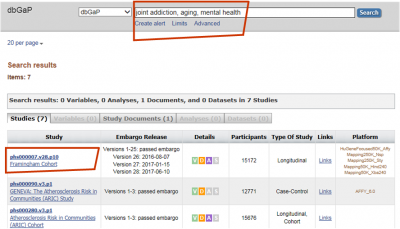
Search for the study from which data are requested. For example, “joint addiction, aging, mental health” results in number of studies.
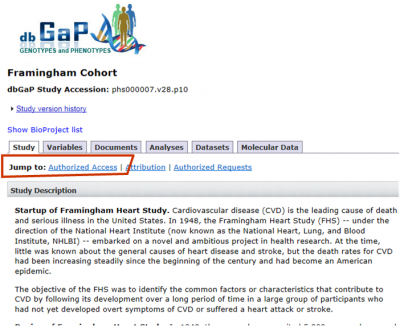
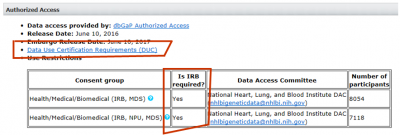
Click on the linked study title of interest for instructions on how to download the model DUC and determine if IRB approval is required. Model DUC and IRB Requirements can be found under the “Study” tab in the “Authorized Access” section (as shown in screenshot).
Complete the Data Security and Data Release Form (MS Word) (PDF).
Email the completed Model Data Use Certification, IRB Approval for dbGaP Data Access (if required), and Data Security and Data Release Reporting form to the AVP for Research, Research IT Services – Dr. Khamis Abu-Hasaballah – at khamis@uconn.edu. Upon verification and approval of these documents, the AVP for Research will issue a certification letter signed by him, the Institutional Chief Security Officer, and the Institutional Signing Official (SPS Director).
This program has been established to support travel costs for postdoctoral fellows who present research results in-person at scientific meetings and symposia. The program will support costs of that travel up to a limit of $700 per fiscal year. Note, HCRAC travel funds cannot be combined with any other UConn travel support.
Awards are made on a first-come, first-served basis, until the funds for this program have been exhausted.
Eligibility
Eligibility for this program is restricted to UConn Health postdoctoral fellows whose faculty preceptor for research is based at UConn Health and contributes their indirect costs to UConn Health.
Applicants must be first author on a research abstract and present a corresponding poster or talk; the topic must be central to postdoctoral research performed at UConn Health.
Postdocs may only receive one travel grant in a given year .
If there are any questions about this travel grant program, please contact Stephanie Holden at 860.679.2513 or sholden@uchc.edu.
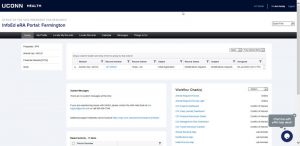
The UConn Health InfoEd is an enterprise-level, web-based application designed to manage all activities related to the management and execution of the research project life cycle – from cradle to grave. The system comprises a suite of modules, each designed to manage a specific aspect of the research project cycle. These include: proposal development and submission to the funding entity during the pre-award phase (Proposal Development – PD) ; proposal tracking and management in the post-award phase (Proposal Tracking – PT); human research protocol application management (Human Subjects Management – HSM); lab animal protocol application management (Lab Animals Management – LAM); environmental safety management (Environmental Safety Management – ESM); intellectual property management (Technology Transfer – TT); and clinical trial management, case report form (CRF) design, and scientific data collection and management (Clinical Trials Management – CTM). Modules currently installed at UConn Health include:
Proposal Tracking (PT) – This module acts as a central clearinghouse of both pre- and post-award information. It provides a single reference point for tracking all details related to proposals including: budgets, subcontracts, approvals, technical reports, and all associated communications.
Financial Conflict of Interests – This module provides researchers with the ability to complete and submit researcher and staff financial interest disclosures electronically. It allows Research Compliance Services staff to track and manage conflicts of interest, establish management plans, and fulfill our policy requirements. The module interfaces with proposals and human subjects. These materials include how-to instructions for UConn Health. Consult the FCOI website at UConn Storrs for the UConn Storrs and Regional Campuses FCOI how-to materials.
Animal Facility Management / CCM Module – The InfoEd Animal Facility Management supports the animal care operations of the Center for Comparative Medicine (CCM) including animal ordering, husbandry, census, and billing of animal facility protocols.
Lab Animal Use / IACUC Module – This module is designed to support the review and management of animal research protocols by the Institutional Animal Care and Use Committee (IACUC).
Tech Transfer (TT) – This module was used to manage administrative data relating to intellectual property and tracks inventors, patents, key dates, contacts, agreements, documents and communications, and financial information tied to expenses and royalties. Now it contains legacy data on some University IP and was replaced by Wellspring Sophia.
SPIN (Sponsored Programs Information Network) – SPIN is a searchable database that provides real-time access to current research funding opportunities. All data in SPIN is obtained directly from the sponsoring agencies themselves to ensure authenticity. To use SPIN, login to InfoEd and then choose Find Funding link at the top of the page.
SMARTS (SPIN Matching And Research Transmittal Service) – SMARTS is an automated system that periodically queries the SPIN database and sends notifications to investigators regarding available funding opportunities in their field of study.
ResearchMatch.org is a national online recruitment tool for health research, funded by the National Institutes of Health and maintained at Vanderbilt University. ResearchMatch connects health researchers with individuals interested in volunteering, through its secure online matching tool. UConn Health is part of the ResearchMatch Network. There is no cost to UConn Health researchers to use ResearchMatch. There are currently over 120,000 registered volunteers across the country. ResearchMatch is also now available in Spanish and simplified Chinese.
To see if ResearchMatch might be a useful recruitment tool for your health-outcomes research study, use this link to register: https://www.researchmatch.org/researchers/. You do not need to be a Principal Investigator to register. The registration process takes less than 10 minutes. Once registered, you will be granted “feasibility access” to search volunteer aggregate data, including geographic and health demographics. Please note that you may not use ResearchMatch to recruit for a registry.
If you decide to use ResearchMatch to conduct participant recruitment, you will need IRB approval:
The Vanderbilt IRB provides oversight for ResearchMatch as a recruitment tool and this has been documented within the ResearchMatch IRB Letter of Understanding (available upon request), but to use ResearchMatch as a recruitment tool for a specific study, you will first need to get UConn Health IRB approval.
For the IRB submission, the following language may be used to describe ResearchMatch as a recruitment method: Potential volunteers will be contacted by ResearchMatch via an email contact message containing IRB-approved recruitment language for this study (not including direct study contact information such as email or phone number). Volunteers will then have the option of replying by clicking ‘yes’ or ‘no’ in the contact message. If a volunteer chooses to respond in the affirmative, they will authorize ResearchMatch to release their contact information to the PI (or ResearchMatch designee) who will be responsible for managing that information according to institutional guideline
The contact message consists of the language to be used in the email sent by ResearchMatch on your behalf to potential participants. Please note that your contact message must not include your direct study contact information (email or phone), and must not exceed 2000 characters. If the study involves in-person participation, you may want to include the geographical location of the study site. If you intend to include healthy controls, specify that in your contact message, otherwise, a healthy control volunteer may decline participation. Please see contact message examples provided by ResearchMatch as well as this form that offers additional tips for creating an effective contact message.
Once ResearchMatch is an IRB-approved recruitment method, you may then register as a researcher to request “recruitment access” in ResearchMatch. You will need to upload your IRB approval letter and your IRB-approved contact message. Recruitment access will give you the ability to send your contact message to potential participants that you select. If a potential participant agrees, you will then have access to his/her contact information in order to contact about possible study participation.
For questions about how to use ResearchMatch for your health research, please contact UConn/UConn Health ResearchMatch Liaison, Ellen Ciesielski,eciesielski@uchc.edu.
 ResearchMatch.org