Conducting Clinical Research Involving Biological Materials at UConn Health
Overview
Clinical research at UConn Health that involves biohazardous human specimens, biological agents, recombinant or synthetic nucleic acids, viral vectors, genetically modified organisms, or live biotherapeutic products is reviewed by the Biosafety Program to ensure appropriate biosafety controls are in place. Working with biohazardous materials may also necessitate Institutional Biosafety Committee (IBC) review prior to study initiation. This page outlines biosafety expectations, review pathways, and investigator responsibilities to ensure safe and compliant research conduct.
When to Consider Biosafety Program Review
- Processing of biohazardous human specimens
- Clinical administration of investigational biological products
- Gene or viral vector therapies
- Engineered cells or genetically modified organisms
- Live microorganisms or microbiome therapeutics
- Infectious agents or biological toxins
Biosafety Review Process
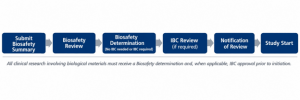
Investigator Responsibilities
- Disclose all biological agents and materials during IRB study submission
- Complete PI Biosafety Summary (Every 2 Years when requested, or as research updates)
Submit here - Obtain Biosafety or IBC authorization before initiating covered activities
- Ensure congruency between clinical protocol, funding, and PI Biosafety Summary or registration.
- Ensure biosafety compliance and staff training (see training requirements below)
- Submit amendments for changes that have the potential to affect biological risk to the Biosafety Office using the PI Biosafety Summary.
Required Biosafety Program and Environmental Health and Safety Training
All personnel involved in clinical research involving biological materials must complete required training prior to study initiation and maintain training as applicable.
For Principal Investigators (PIs)
1. Initial Lab Safety (Chemical & Biosafety / Bloodborne Pathogens Training link
2. CITI PI Biosafety/Biosecurity Training (Every 3 Years) CITI Program
Register an account and be sure to affiliate to University of Connecticut Health Center
We have a contract with CITI Program for online compliance training (https://about.citiprogram.org/en/homepage/ ). To access it you need to register (upper right of homepage) as an affiliate of “University of Connecticut Health Center” (and no other). Once you register and promise not to divulge the material in the trainings to others, you will need to navigate to the courses:
- When you come to “CITI Course Enrollment Procedure”
- Scroll all the way to the bottom under “question 8”
- Click the checkbox next to “PI” under Biosafety/Biosecurity
- Click the “Complete Registration” box
- Click the “Finalize Registration” box
- Click “view courses” in the upper part;
- Note: If you do not see courses as below, scroll down to “Learner Tools for University of Connecticut Health Center” and click “Add a course”. This will take you to the Select Curriculum page where you scroll all the way to the bottom where it says “Question 8”.
- Choose your learner group
- Click “Start Now”, agree to the Assurance statement, and take all modules in the course. There are quizzes
3. DOT/IATA Shipping / Transport Training (If moving or shipping biological samples)
Watch video
4. Annual Bloodborne Pathogen refresher training ongoing through SABA, Healthstream, or the EH&S Training page (annually after Initial Lab Safety training)
For Research Staff
- Initial Lab Safety (Chemical & Biosafety / Bloodborne Pathogens
Training link - Annual Bloodborne Pathogen refresher training ongoing through SABA, Healthstream, or the EH&S Training page (annually after Initial Lab Safety training)
- DOT/IATA Shipping / Transport Training (If applicable)
Watch video
Additional EH&S trainings may be required. Per UConn Health’s policy and OSHA’s Hazard Communication Standard, also known as “The Laboratory Standard” it is mandated that ALL people working in laboratories covered by the standard at UConn Health (including the vivarium and TIPS space) require training upon their initial assignment. This is in addition to the basic training they attend at orientation. The training in the safe use of chemicals, biosafety, emergency response and waste management is essential for a safe working environment.
EH&S training website
https://ovpr.uchc.edu/services/rics/ehs/safety-training-sessions/
EH&S Contact Information:
If Biosafety Review Was Missed
If clinical research involving biological materials is identified without required BioSafety review, the UCH
Biosafety Program will perform a risk assessment and coordinate corrective actions to achieve
compliance. Approvals apply prospectively; retrospective approval cannot be granted.
- IBC submission or amendment required
- Potential activity pause for higher‑risk work
- Reportability assessment under regulations/policy
- Training or process improvements as needed
Copilot language:
Identification of Clinical Research Involving Biological Materials Without Required Biosafety Review
If clinical research involving biological materials is identified without the required Biosafety review and approval, the UCH Biosafety Program will work collaboratively with the research team to assess potential risks and determine appropriate corrective and preventive actions (CAPA). Our primary goal is to ensure the safety of personnel, participants, and the environment while helping investigators achieve compliance moving forward.
Because Biosafety approvals can only be granted prospectively, retrospective approval cannot be provided for activities that have already occurred. However, in most cases, the review process will focus on understanding the circumstances, addressing any gaps, and implementing appropriate measures to prevent recurrence.
Potential outcomes may include:
- Submission of an IBC application or amendment to document and review the activity.
- A risk-based assessment to determine whether any research activities should be modified or temporarily paused while review is completed.
- Evaluation of whether reporting obligations exist under applicable regulations, institutional policies, or sponsor requirements.
- Additional training, process improvements, or other corrective actions to support ongoing compliance.
The Biosafety Program is committed to partnering with investigators to address issues proactively and promote a culture of safety and compliance.
Contact Biosafety
Contact the Biosafety Program Office with any questions or for more information: IBC@uchc.edu.